
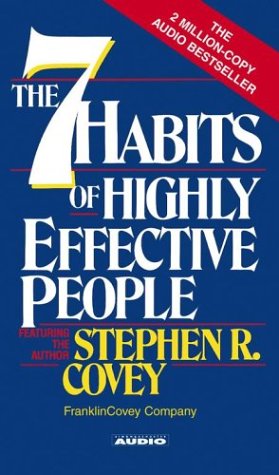
The seven habits of highly effective people / Stephen R. Covey
Material type: SoundPublisher number: 68796-4 | Simon & Schuster Sound IdeasPublication details: New York : Simon & Schuster Sound Ideas, 1989Edition: 1st edDescription: illISBN:
 - 0671687964 :
- Seven habits of highly effective people
- 813.54
| Cover image | Item type | Current library | Home library | Collection | Shelving location | Call number | Materials specified | Vol info | URL | Copy number | Status | Notes | Date due | Barcode | Item holds | Item hold queue priority | Course reserves | |
|---|---|---|---|---|---|---|---|---|---|---|---|---|---|---|---|---|---|---|
 Books
Books
|
Centeral Library First floor - Languages | 813.54 C.S.S 1989 (Browse shelf(Opens below)) | Available | 3287 |
The 7 Habits of Highly Effective People, first published in 1988, is a business and self-help book written by Stephen R. Covey.[1] Covey presents an approach to being effective in attaining goals by aligning oneself to what he calls "true north" principles of a character ethic that he presents as universal and timeless.
Covey defines effectiveness as balancing obtaining desirable results with caring for that which produces the desirable results. He illustrates this by referring to the fable of the "Goose That Laid the Golden Eggs". He further claims that effectiveness can be expressed in terms of the P/PC ratio, where P refers to getting desired results and PC is caring for that which produces the results.
There are no comments on this title.